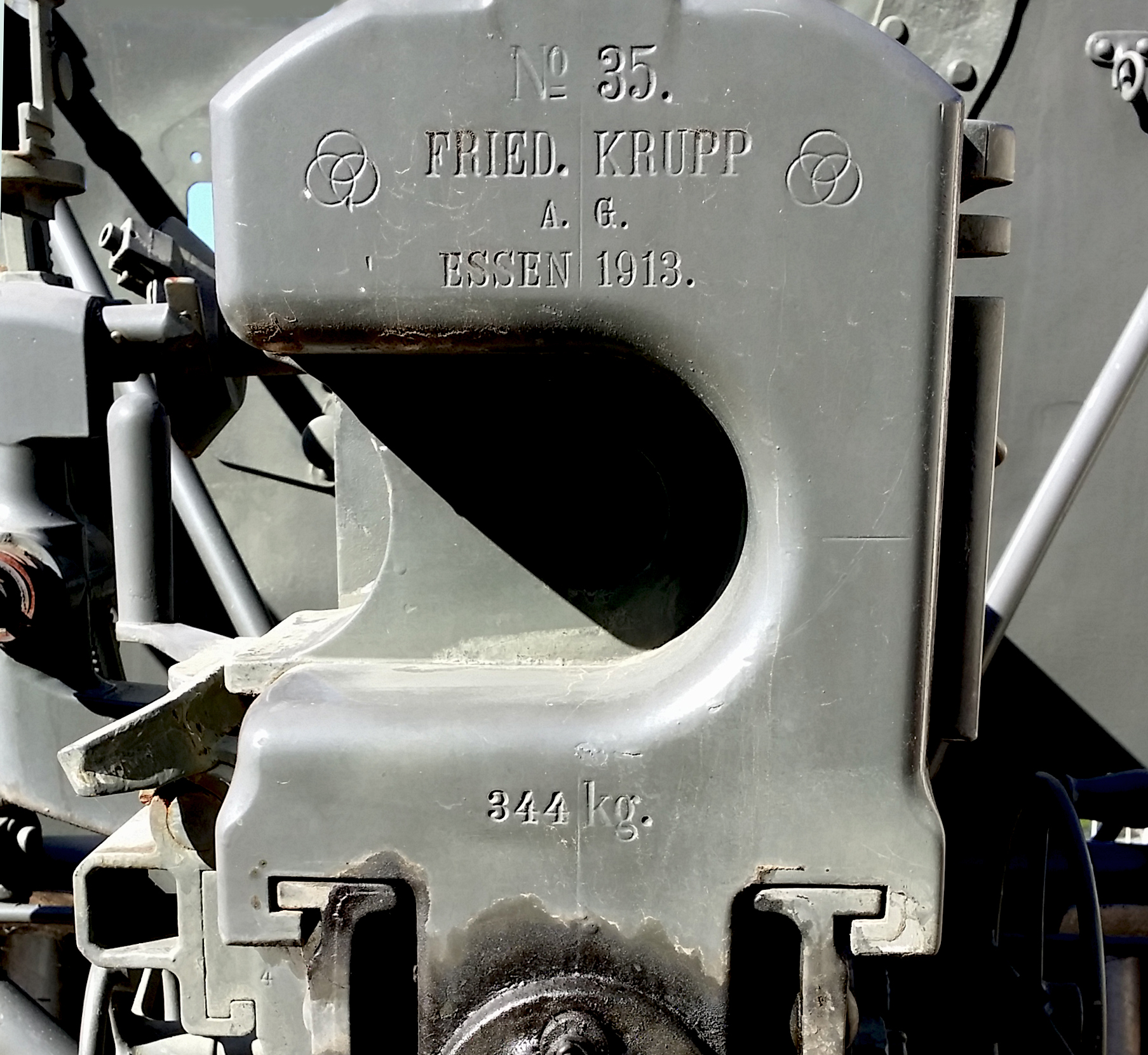
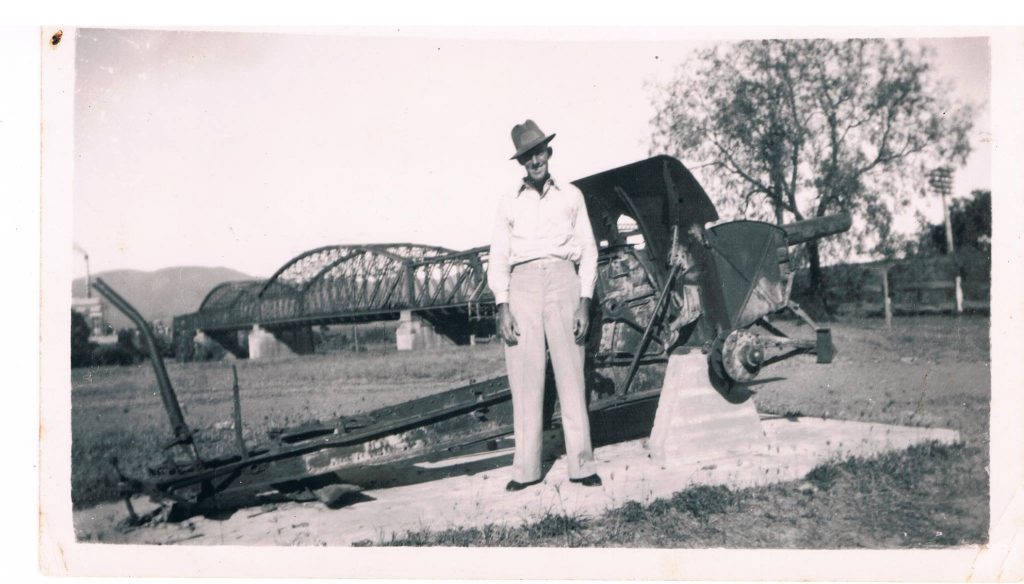
First published in 2014 by Dell Dallach, this image (above) notionally depicts her uncle William Holland in Rockhampton’s Victoria Park.
Taken some time between 1938 and 1960, it also features – in the background – one of the three large-calibre German guns gifted to the city in 1922 by the Queensland War Trophies Committee. Anticipating a flood of applications when it first convened in 1922, the Committee had determined to allocate these captured artillery pieces on the basis of population (rather than enlistments). In the event however, due to the ‘apathy shown by many allottees’ it found itself left with a surplus of field guns, mortars and machine guns.
The public’s diminishing interest in these bellicose symbols, already evident throughout Queensland in the years immediately following the Armistice, increased with each subsequent year and shows no sign still of abating. Initially displayed prominently within the Town Hall reserve, the City of Rockhampton’s two trophy guns, a 10.5 cm leFH 16 (shown here in Dell Dallach’s picture) and a 15 cm sFH13 had, by 1938, been unceremoniously removed to Victoria Park – near the city’s north-western outskirts. In justifying the move the Chairman of Council’s General purposes committee described the guns as ‘unsightly.’[1]
This move can be seen as part of a much broader cultural shift caused, in part, by changing public attitudes towards war, military commemoration, town planning and aesthetics. Toowoomba’s long-serving Mayor Annand for example had openly called for the removal of First and Second World War trophy guns from that city’s public spaces, referring to them as ‘beastly weapons.’ In this respect he was not alone, similar campaigns having been successfully prosecuted in Maryborough and Brisbane (after WWII).[2]
Between 1946 and 1962 Brisbane City Council’s Parks Department systematically removed and disposed of every item of obsolete artillery from every public space within its sphere of influence. As a consequence, scores of colonial, Boer, World War I and World War II guns were removed from the city’s parks and corralled into Council’s Crosby Park Depot pending disposal. So determined was Council to be rid of these bellicose symbols that it even began openly advertising (Sunday Mail, 2 March 1958) that it had guns to give away.[3]
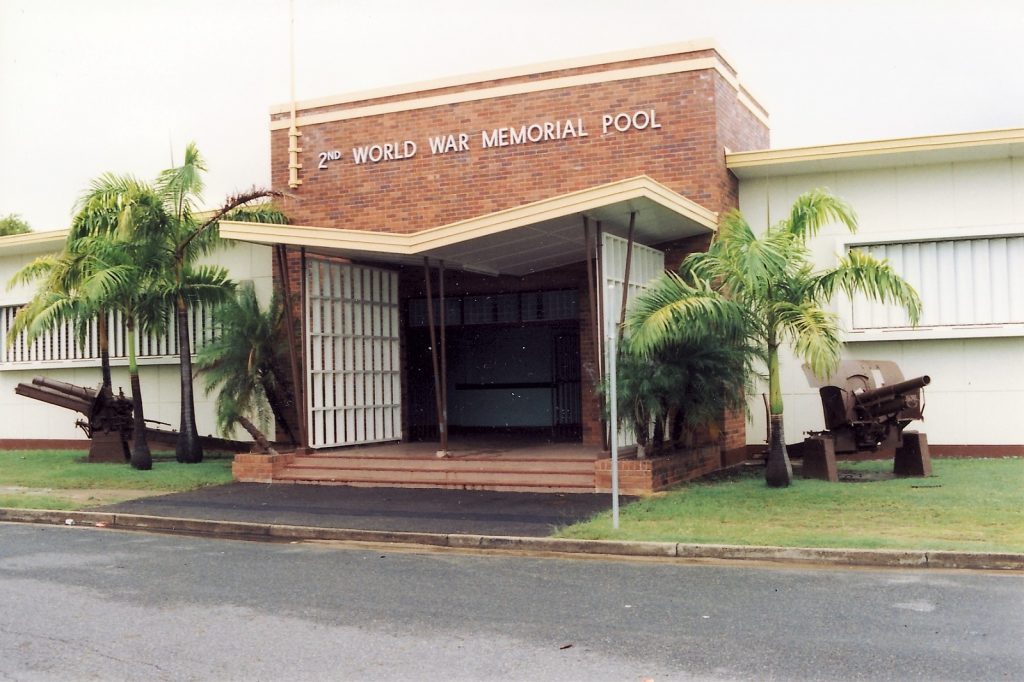
Rockhampton City’s war trophies fared somewhat better, being re-purposed for entrance guard duty firstly when the City’s 2nd World War Memorial Pool opened in 1960, and again in 2016 when the 2nd World War Memorial Aquatic Centre was completed.
Not so fortunate however was the 42nd Battalion’s sFH 02 15cm howitzer, first displayed at the corner of Alma and Archer Streets in 1920.[4] Thought to have been removed from public display late last century, it can only be glimpsed now through the cyclone wire fence encircling the Army’s Western Street compound.

In 1922 the Rockhampton Boys’ Grammar School Trust was also allocated a captured 75 mm German mortar.[5] Like so many other Australian war trophies, it is also thought to have been removed from public display long ago, and since discarded.
[1] “Removal of war trophies from Town Hall reserve,” Morning Bulletin (Rockhampton), 9 June 1938, 13, https://trove.nla.gov.au/newspaper/article/55977196.
[2] “War Trophies,” Morning Bulletin (Rockhampton), 2 November 1934, 9, https://trove.nla.gov.au/newspaper/article/54777990.
[3] Seeds of Discontent, Queensland History Journal, Vol.23 No.9 (May 2018) p. 563.
[4] “War trophies for Rockhampton,” Morning Bulletin (Rockhampton), 1 July 1920, 8, https://trove.nla.gov.au/newspaper/article/53964282.
[5] “Trench mortar for Boys’ Grammar School,” Morning Bulletin (Rockhampton), 27 July 1922, 8, https://trove.nla.gov.au/newspaper/article/54004726.