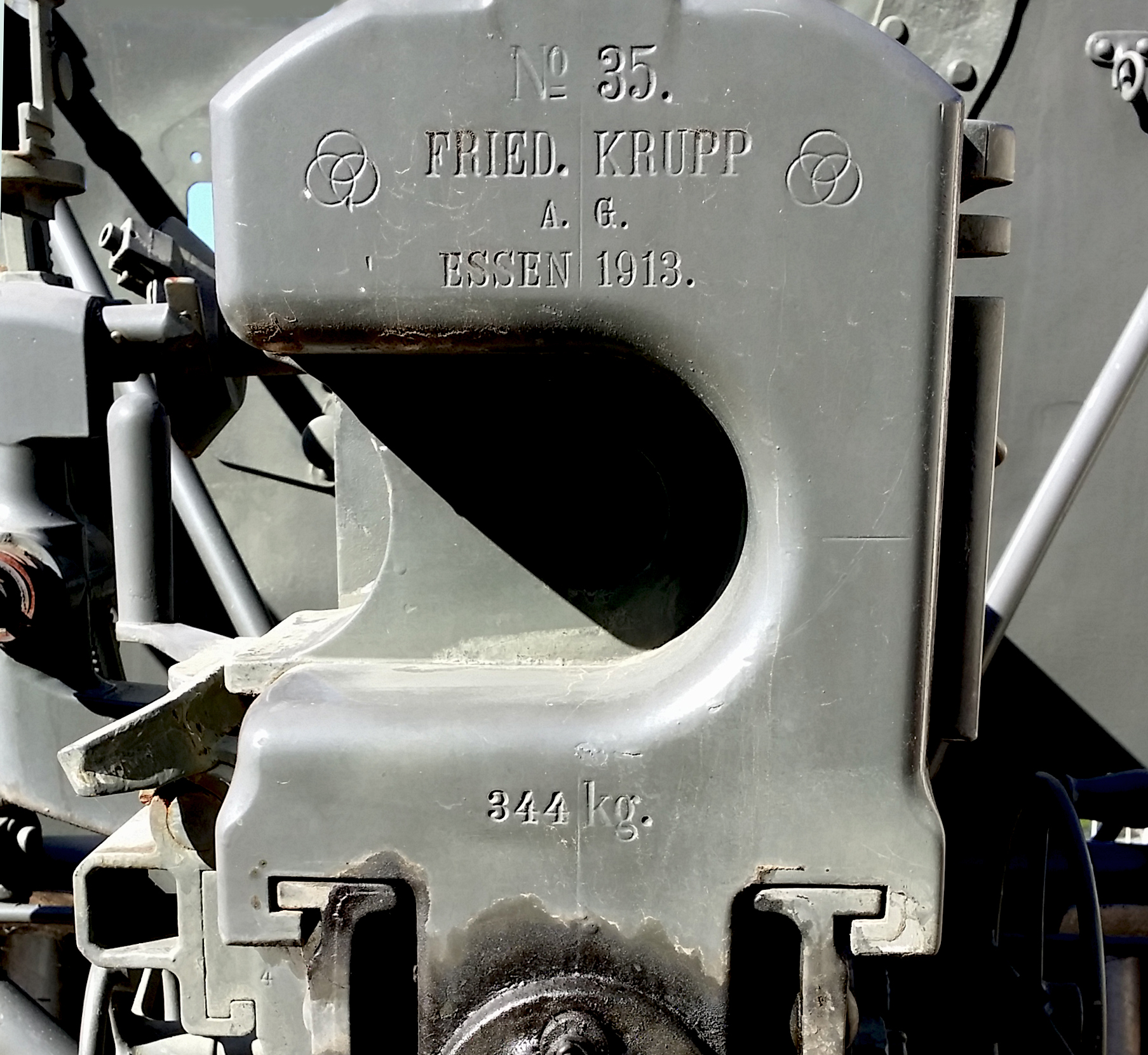
The Battle of Amiens which began on 8 August 1918 in north-western France is considered the greatest allied victory of the First World War, an action that ultimately led to Germany’s surrender three months later. British, Australian and Canadian ground forces advanced over 11 kilometres on that first day (one of the greatest advances of the war), in the process capturing 29,144 prisoners and 338 guns, and liberating 116 towns and villages.
One of the guns captured during that now famous opening advance was subsequently brought to Australia and gifted to the citizens of Sherwood (Brisbane) in 1921. A century later, and all that remains here in Queensland of that war trophy is its bronze dedication plaque…itself having been souvenired.
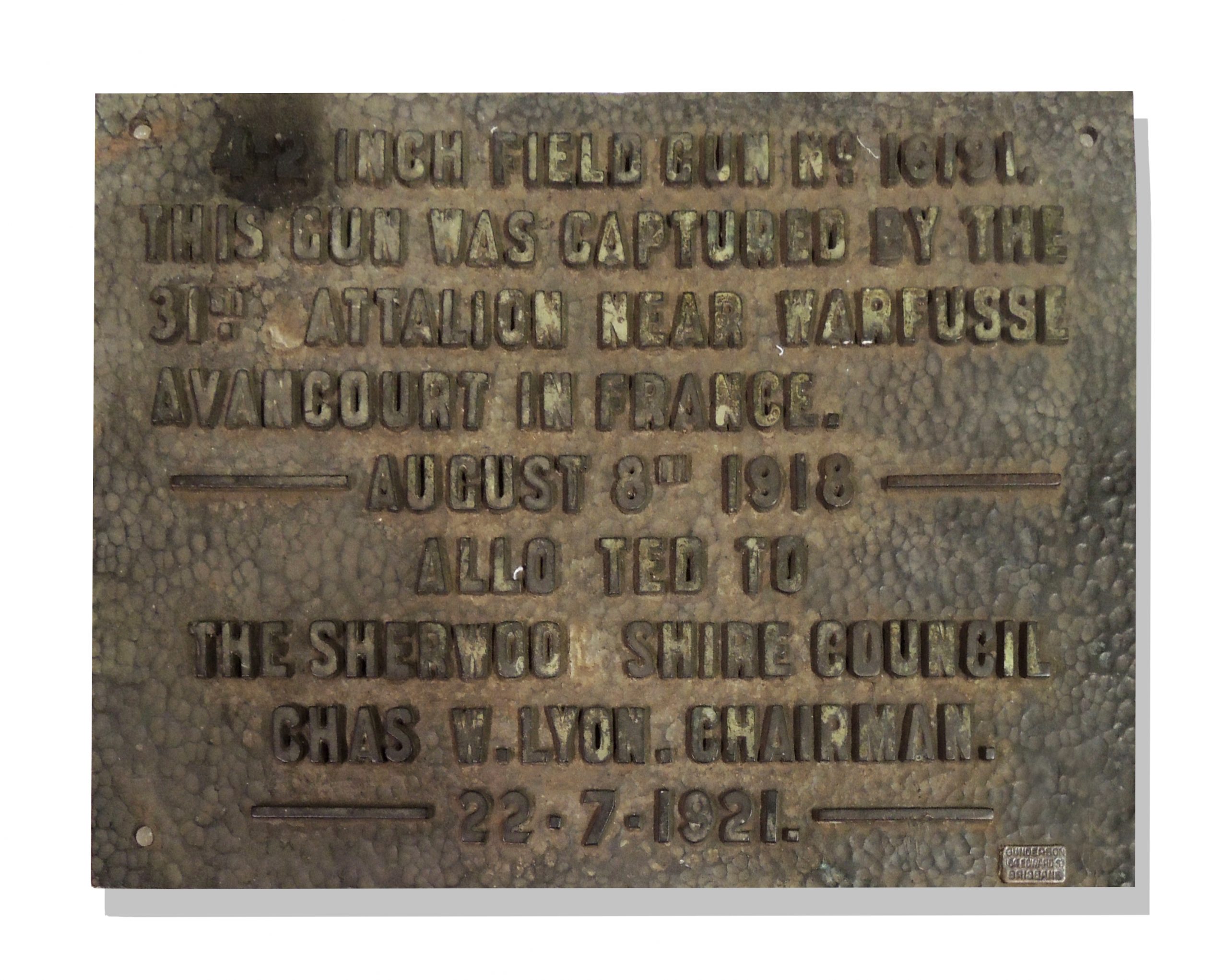
At least five captured German field guns were allocated to Brisbane municipalities after the war by the Queensland War Trophies Committee, a ballot system having reportedly been used to determine final allocations (to Brisbane, South Brisbane, Sandgate, Sherwood and Toombul). Fifteen captured machine guns and three mortars were simultaneously issued then to other metropolitan municipalities, prompting the Telegraph in September that year to forecast ‘an outbreak of unveiling ceremonies.’
In Council the previous month, the Sherwood Chairman reported – with obvious satisfaction – that the trophy allocated to their municipality had been ‘captured by the 31st Battalion, A.I.F., near Warfusee, Avancourt, in France during the opening phase of the Australian advance in the great offensive of the 8th August, 1918,’ adding that ‘ it was decided to mount the gun on a concrete base in the Graceville Memorial Park, with a dedication plate attached, and that the Returned Soldiers and Sailors’ League [would] be requested to cooperate in a public ceremony. The chairman advised that the old men’s auxiliary of the Red Cross would undertake the renovation of the gun.’ 1

This was welcome news for Sherwood’s citizenry who, at the time, were still coming to terms with a shocking incident a few months earlier when…’some ghoulish minded creature or creatures [had] committed an act of profanation at the [nearby] Graceville Memorial Park, of wilfully pulling out of the ground certain young trees and memorial crosses which had been planted and placed there by the Sherwood Council to perpetuate the memory of the district’s glorious dead who “gave themselves that we might live unhurt behind the thunder of the guns.”…Returned soldiers [had] promised the offender, if he comes within their grasp, an administration of tar and feathers.’ 3
Whereas the trophy gun’s dedication at Graceville Park was never reported, the circumstances of its capture in France, three years earlier, were briefly mentioned by the 31st Battalion’s diarist (and company commander) Captain George Herbert Wilson. 4 Formerly a Brisbane school teacher, thirty-one year old Wilson’s unit diary entry of August 8th, 1918 is typically understated…
Machine gun fire was brought to bear on the anti tank guns (three 4.2’s) and the crews immediately took refuge in dugouts and were effectively dealt with when the advance reached them. 5
Following the war, in November 1920, a fourteen foot high granite war memorial was erected within the fourteen acre council parkland reserve at the northern end of Oxley Street, referred to thereafter as the Graceville Memorial Park. Claimed to be ‘one of the finest recreation reserves in Brisbane,’ it was here alongside this granite obelisk that Sherwood’s trophy gun was also later installed as a permanent, albeit, ‘grim reminder of the war.’ 6
Attitudes towards military commemoration however shifted dramatically during the subsequent decades, the evidence for this nationwide change being most evident within the Queensland capital. Between 1946 and 1962 Brisbane City Council’s Parks Department systematically removed and disposed of every item of obsolete artillery from every public space within its sphere of influence. As a consequence, scores of colonial, Boer, World War I and World War II guns – including Sherwood’s war trophy – were removed from the city’s parks and corralled into Council’s Crosby Park Depot pending disposal. 7 So determined was Council to be rid of these bellicose symbols that it even began openly advertising (Sunday Mail – 2 March 1958) that it had guns to give away.
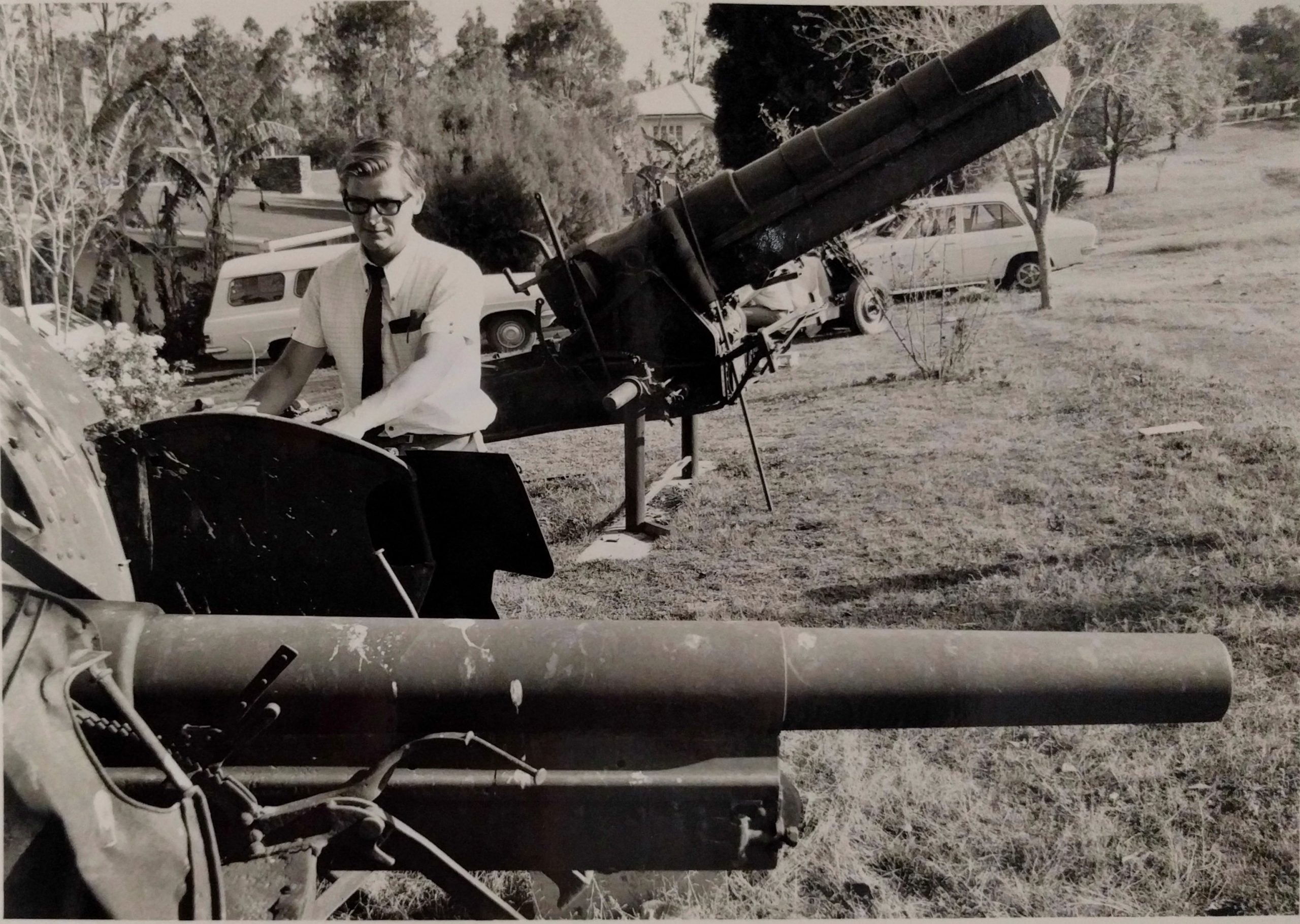
Ironically, amongst the many applications received by Council was one from the residents of Glenwood and Queenscroft Streets in Sherwood requesting ‘any gun’ suitable for mounting in parkland – presumably to replace that which had stood alongside the Graceville Park war memorial. 8
They were unsuccessful.
_______________________________________________________________
- SHERWOOD SHIRE COUNCIL,The Telegraph . 20 August 1921, page 2
- (AWM4 23-48-37 page 97)
- ‘Desecration at Graceville’, The Telegraph, 20 June 1921, page 5
- NAA: B2455, WILSON G H
- AWM4 23/48/37 page 97
- DO YOU KNOW YOUR BRISBANE ?, Sunday Mail, 24 Mar 1929 page 19
- Seeds of Discontent, Queensland History Journal, Vol.23 No.9 (May 2018) p. 563
- Brisbane City Archives [BCA], File BCA0275 Guns in parks including Carron Cannons, Brisbane City Council, 1921-1999)
The Toombul gun is still there – in Nundah Memorial Park, in front of the Nundah State School. The gun was refurbished by the Nundah-Northgate RSL Sub Branch, about a decade ago. The gun’s painted camouflage scheme is as accurate as could be determined from available records.
Nundah was part of the Shire of Toombul until the merger of shires and municipalities into the City of Brisbane, in 1925.